How to Draw Frills on Clothes: A Step-by-Step Guide by Japanese Pro Artists
If your frills come out as a flat zigzag or a wobbly line, you are only drawing the edge. This guide covers how a frill is built, how the amount of gathering changes it, and how to draw stiff, uneven and tiered frills.
 Construction study
The five stages at a glance
 01
 02
 03
 04
 05
Step 01 · How a frill is built
How is a frill actually built?
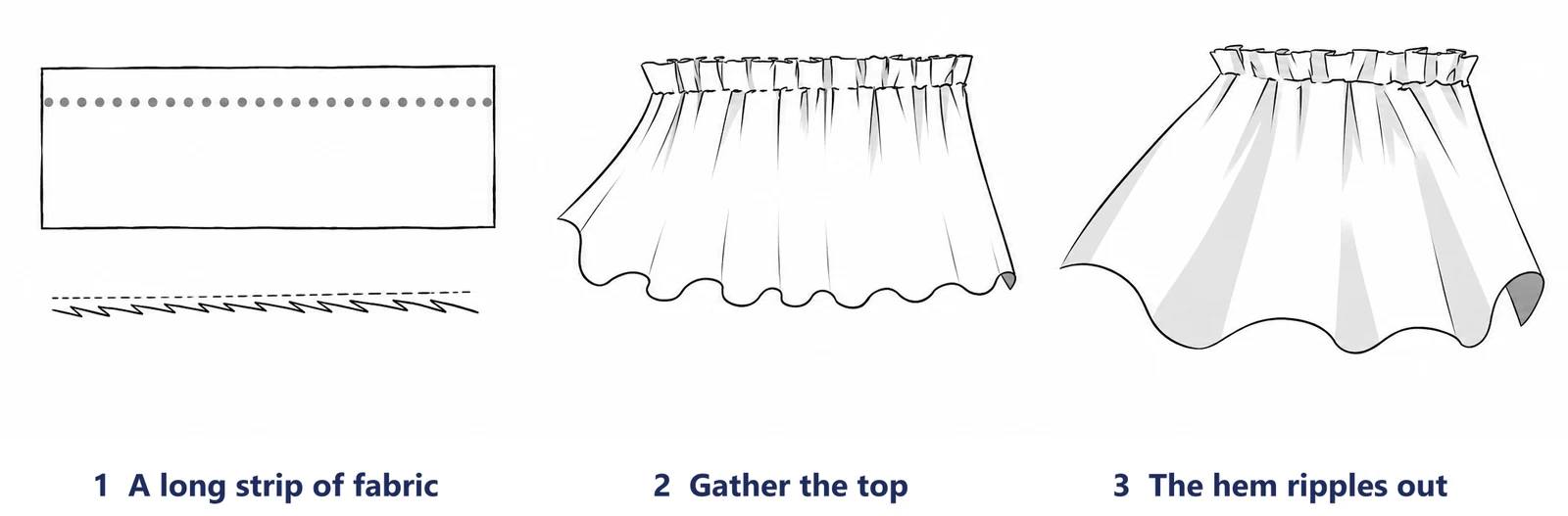
Take a long strip of fabric, gather the top edge, and the bottom edge ripples out on its own.Every frill starts as a plain rectangle. Run a gathering stitch along the top, pull it tight, and the top bunches into small folds.
Because the top is now shorter than the bottom, the bottom edge has nowhere to go but out, so it ripples. The fabric, its size and how much you gather it all change the shape. Keep track of where the front of the fabric shows and where the back shows, because turning the frill to a new angle changes that too.
Construction study
Step 02 · Small vs large gathers
How do small and large gathers change a frill?
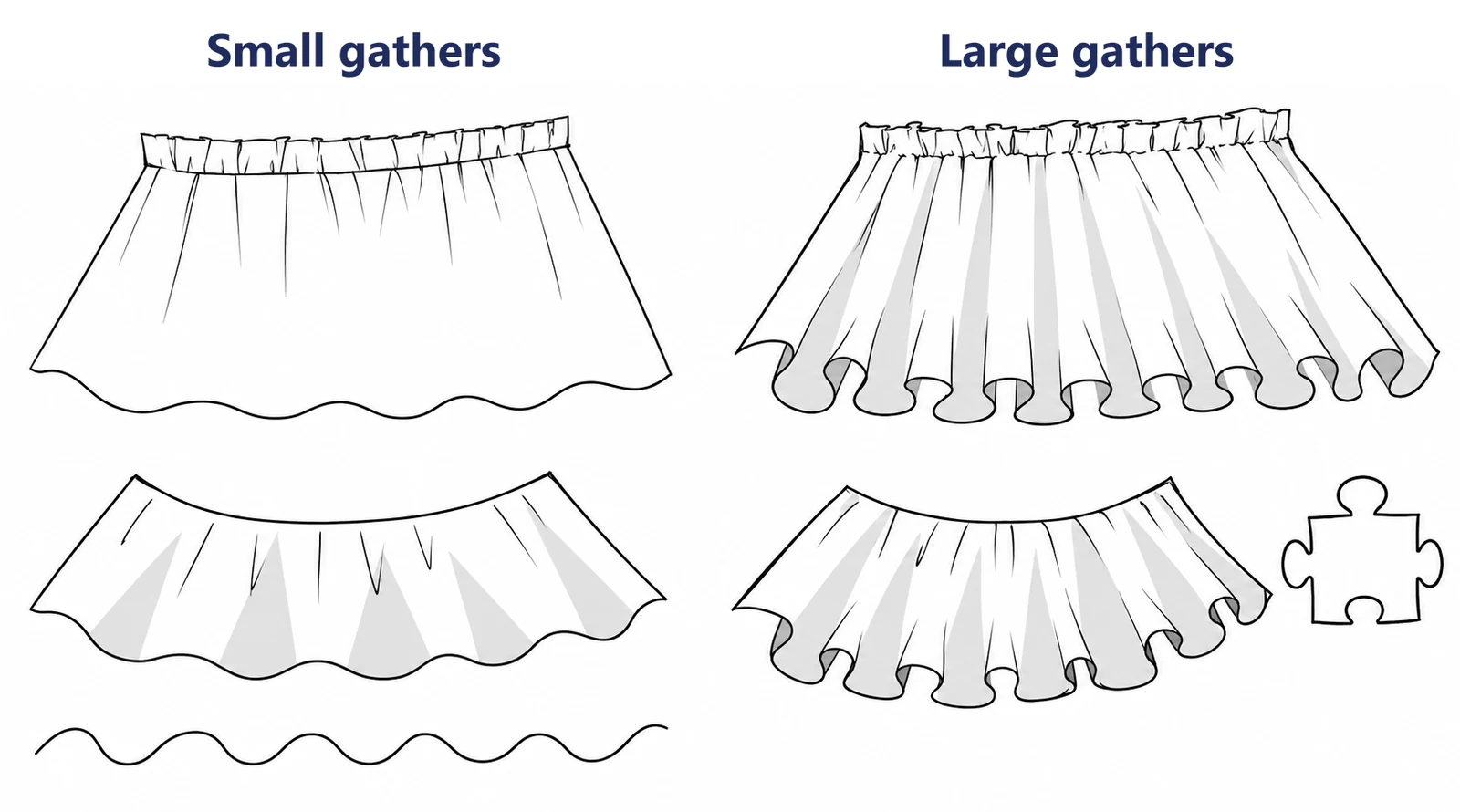
Small gathers make soft, even waves. Large gathers make deep waves where you can see the back of the fabric.With small gathers, the waves are gentle and regular and you never see the back side. Folds appear only where the fabric was gathered, and shadow sits in the dips of each wave.
With large gathers, the waves get big and you see the back of the fabric. The waves can turn irregular, and folds show up at the hem too, not just at the gathers. Each wave looks a bit like a puzzle piece. Shadow goes in the dips, on the back side and on the gathered part.
Construction study
Step 03 · Stiff fabric frills
How do you draw a frill in stiff fabric?
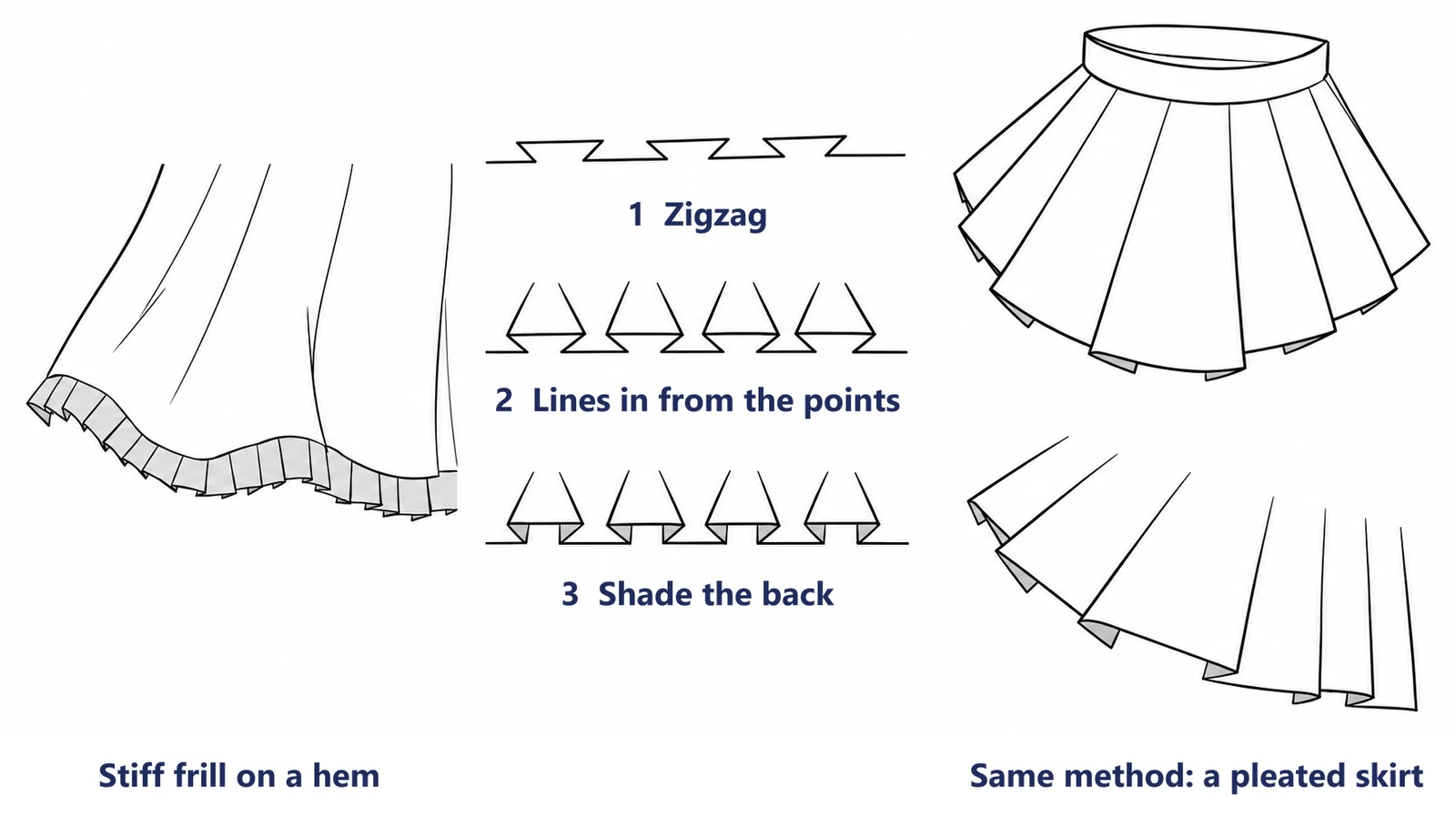
Stiff fabric is made of straight lines, not curves. Draw a zigzag, pull lines in from the points, then shade the back.A frill in stiff fabric does not wave. It is built entirely from straight lines. First draw a row of sharp bumps. Then, from the tip of each bump, draw a straight line inward. Finally, add a line where the back side shows and shade that back side.
Be careful with the size: make the zigzag too big and it stops being a frill and turns into a pleated skirt. In fact, the same steps give you a pleated skirt.
Construction study
Step 04 · Uneven gathers
How do you draw uneven, irregular frills?
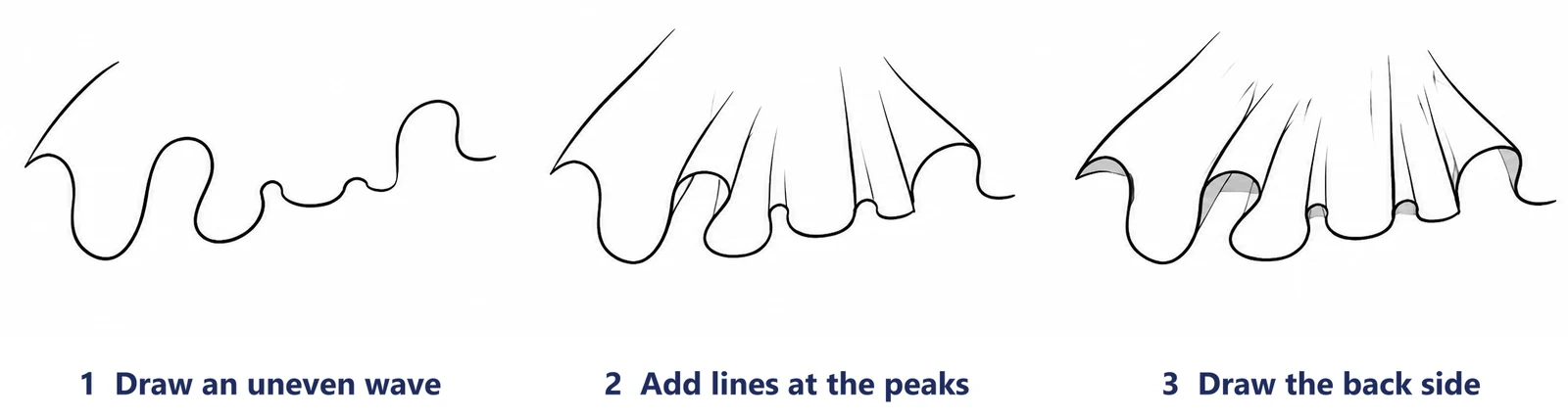
For uneven gathers, like a skirt hem, start with an irregular wave, then add lines and the back side.Draw an irregular wave first, with some big swings and some small ones. Then add a line at each part that sticks out.
Last, draw the back side inside the waves. Thinking about the front and the back of the fabric is what makes the frill look three-dimensional.
Construction study
Step 05 · Tiered frills
How do you draw tiered frills?
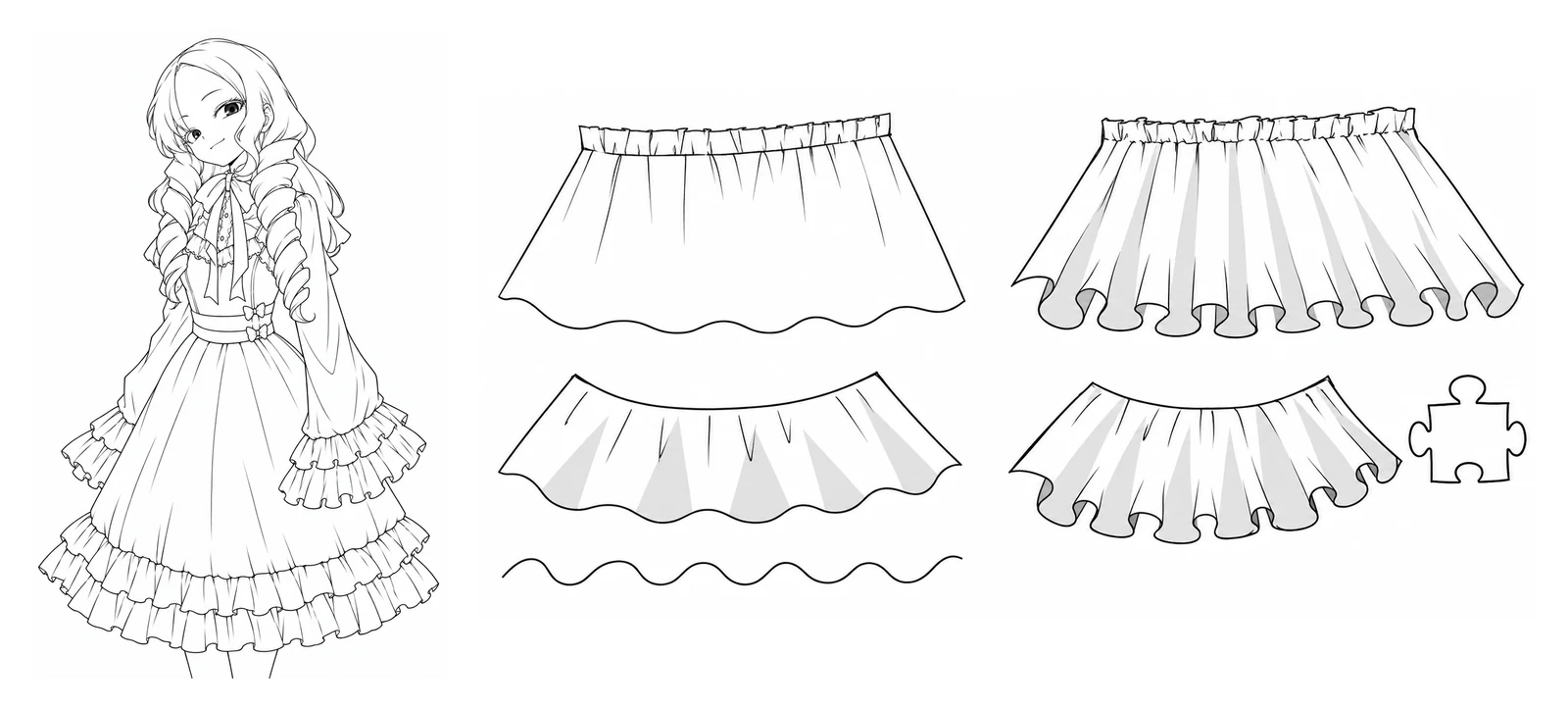
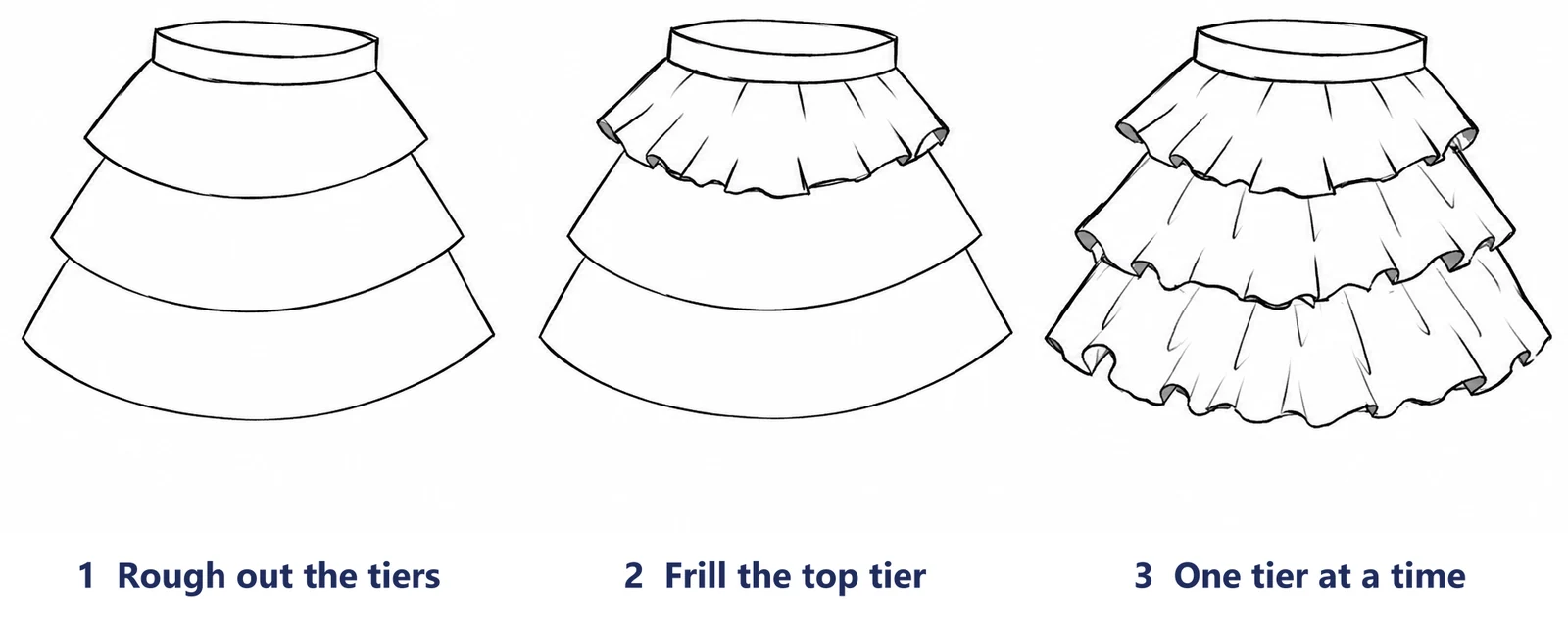
Rough out the tiers first, then add the frills from the top, one tier at a time.Sketch the skirt as stacked tiers before any frills. That rough shape keeps every tier the right size.
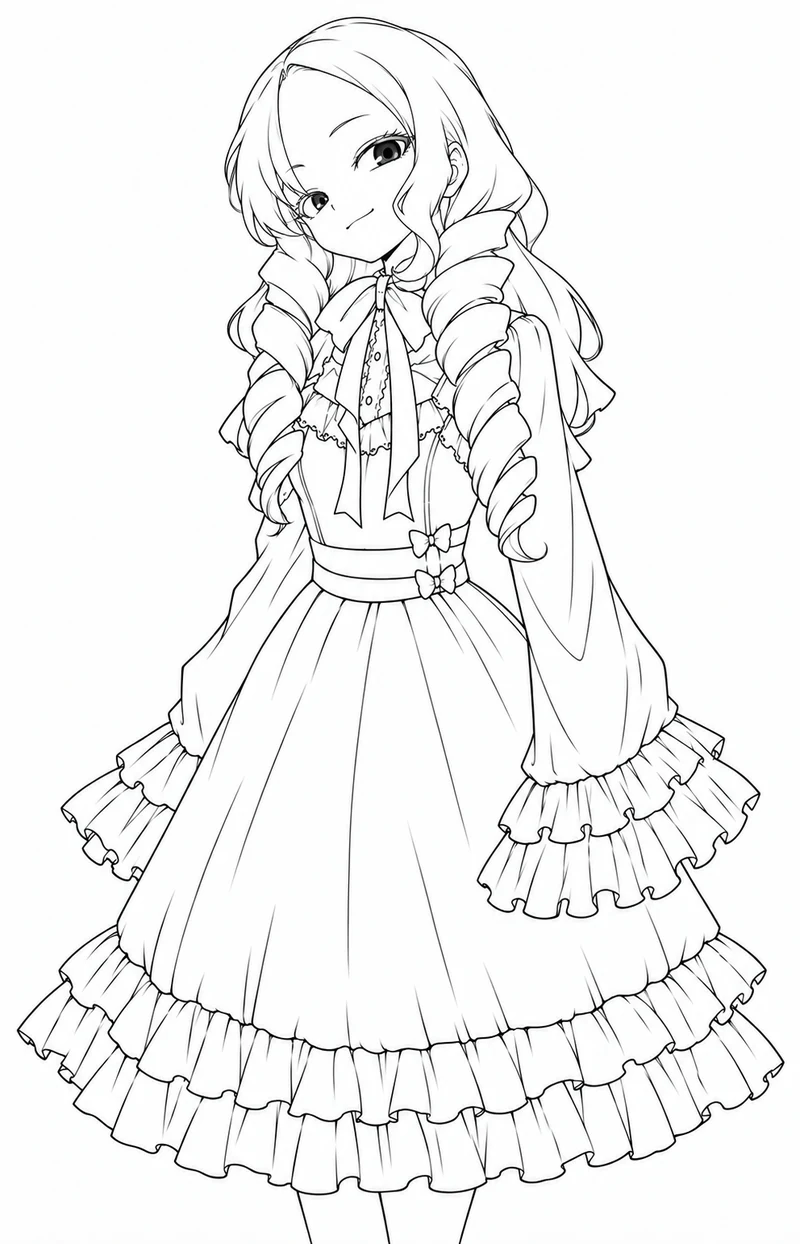
Then follow the rough and add the frills starting from the top tier, one tier at a time. The finished dress below uses the same layered frills on the sleeves and the skirt hem.
Construction study
 Finished example
Where people usually get stuck
My frills look like a flat zigzag.
You are drawing only the edge. Add the gathered top and the back side of the waves, and the frill gets depth.
My frills look stiff and evenly spaced.
For a hem or a loose skirt, use uneven gathers and vary the size of the waves (Step 04).
My tiered skirt gets lopsided.
Rough out the tiers first and keep each one the right size before you add any frills.
Frills drawing FAQ
How do I make a frill look full?
Gather it more. Larger gathers make bigger waves, and you start to see the back side of the fabric. Shade that back side and the dips between the waves.
Why does my frill look like a pleated skirt?
Your zigzag is too big or too straight. A stiff frill and a pleated skirt are drawn the same way, so keep the bumps small if you want a frill.
What is the easiest way to draw a tiered frilled skirt?
Rough out the tiers as stacked shapes, then add the frills one tier at a time, starting from the top.
How do I get feedback on my frills drawings?
When you join an Anime Art Academy course, a professional Japanese artist gives you personal advice and draws red-line corrections directly on your drawing. There is no limit on how many times you can submit. The only rule: post one drawing at a time, and wait for your teacher's reply before posting the next.